
The leopard slug (toxic?): identification, feed, reproduction

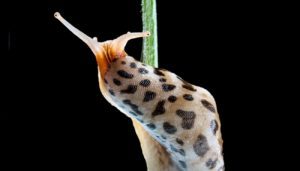
Like a big cat, I sometimes prowl your gardens. My mottled coat makes me unique among the rest of us crawling land molluscs!
I’m limax maximus (Latin limax: slug and maximus: big).
I rightly bear my Latin name, as I can grow up to 20 cm!
I’m sometimes called tiger slug, spotted slug, but also ashy slug, large gray loche, large ashy slug, or large gray slug.
But even though I’m known as the white wolf, there are a lot of questions about me:
- What do I eat? Do I really eat other slugs?
- Am I poisonous, and therefore dangerous for your chickens or ducks?
And did you know that my reproduction is an exceptional phenomenon in the living world?
You can see it all in what follows! You’ll see, I’m an extraordinary slug.

If you've discovered my blog, you're probably bothered by slugs and snails.
You'd probably be very interested in the 7 Steps to get rid of slug by attracting the Alpha predator I have designed with the help of Science, and The slug-proof garden Design I have made (with the help of dozens of scientific studies too).
It changed everything for me. I can finally grow lettuces, cabbages, strawberries and cucurbits without pulling the hair out of my head.
Don't hesitate, you'll probably save a lot of time!
Before you start, if you’re interested, here’s the
article on all slug predators
.
I. The leopard slug (or tiger slug) under the microscope
a. How to recognize a leopard slug
So let’s get off to a good start. Why is the leopard slug (leopard meaning spotted coat, and it’s also called a spotted slug, by the way) also called the tiger slug?
You can tell the difference between a tiger and a leopard, can’t you? Between striped and polka-dot pyjamas?
In fact, I originally thought that the name “tiger slug” was a linguistic error. But, as I took the time to observe, I realized that young leopard slugs have stripes of sorts (actually spots in a line) along their bodies (and not across like tiger aces). These stripes tend to disappear (the spots move away from each other) as the slug becomes adult, but dotted stripes can still be seen (and always along the body) on the rear of the slug.
On the other hand, you’ll notice that 3 mm-diameter spots are clearly visible on the front of the leopard slug (in the so-called “shield”, near the head), from a very young age.
When the slug is young, it can sometimes be seen as both tiger and spotted (a mischievous cross between the two famous bush animals). These markings are black on a grayish-brown to pinkish-brown body.

Here we have a beautiful little leopard slug: mottled on the front and more tiger-like on the back.
b. Anatomy of the leopard slug
Apart from the color of its coat, what are the anatomical particularities of the leopard slug?
– The pneumostome (the slug’s respiratory organ) is located at the back of the shield.
– The carina, a small ridge on the slug’s “back”, is short and stops short of the shield.
– Concentric folds are present in the slug’s shield.
It’s a pity that these anatomical features are common to all subspecies of grey slugs, of which the leopard slug is one. It won’t help you decide between a leopard slug and a grey slug, but I thought it was worth learning more about this species.
c. Behavior and observation sites
The tiger slug, like all slugs, sleeps during the day, when the weather is dry, hidden in dark, damp places: in your mulch, in your compost bin, under stones or dead wood, and even buried under the ground! When it rains, or at night, when the humidity drops, they come out and you can spot them in your garden.
Leopard slugs are also found throughout southern and western Europe. They are slightly less common around the Mediterranean.
II. Leopard slug diet: does it really eat other slugs?

The answer is yes!
In fact, the leopard slug is omnivorous: its diet consists of plants (like other slugs), fungi (which it loves, including pathogenic fungi such as powdery mildew, whose propagation it stops by digesting the reproductive spores), but also other slugs!
” Ok ok, it eats other slugs, but it only eats dead slugs, or can it kill and eat live, healthy individuals? Because there are many species of slugs that nibble their dead counterparts”.
Yes, the leopard slug eats slugs but she also goes so far as to track down (the word may be a bit strong, let’s say “hunting”) and kill other slugs ! It moves faster than most other specimens (up to 15 cm/minute)and can thus prey on them. How big are the potential prey slugs of the leopard slug is another question. What’s certain is that it feeds on the eggs of other slugs, as well as smaller specimens (see video below). Can it attack an orange loche? Good question, I’ve found absolutely nothing on the subject.
Even if the leopard slug can eat certain plants (which isn’t such a bad thing, because as I said, it limits the spread of cryptogamic diseases), it really is a friend to have in the garden!
It’s not easy to see, but this leopard slug is eating a small grey slug.

Robin
A passionate experimental vegetable grower, I had huge slug problems during my first 2 years of vegetable gardening.
Nothing (eggshells, ashes, etc.) seemed to work…
And yet, if the Internet was to be believed, everything was supposed to work…
In short, faced with an obvious problem of misinformation, I decided to take action: I tested all the famous “slug barriers”, so as to have a clear mind, and know what to do.
I filmed my (13) tests(here, in French)
The results were crystal clear: nothing was able to effectively block the path of slugs and snails, except Water, usable with trenches at least 5 cm deep and 10 cm wide, or Copper, if used vertically, if its height is at least 7 cm
But a water-based barrier is difficult to implement, and copper is expensive…
It was by turning to scientific studies that I found the solution: adopting a slug predator in the garden, present everywhere in the world, which has a huge regulatory effect on them.
The studies show it. And I called this predator the Alpha predator of slugs.
Using dozens of scientific studies again, I constructed an action plan of the most effective arrangements to attract this Alpha predator to the garden sustainably, and to see it multiply by itself, year after year, season after season.
And to get rid, definitively (and intelligently), of slugs.
I have gathered these 7 steps in a digital book that I propose on this site, and at the end of the book, there is also a video training module on designing a slug-proof garden.
You can find this digital book (which contains all of this) by clicking here.
And what if you don’t get rid of your slugs by following the advice in this book? It’s simple, I will refund you in full (but it will work, if you follow the instructions properly).
So, don’t hesitate to discover the simple 7 Steps that can change your springs.
III. Are leopard slugs poisonous, and therefore dangerous for your pets?
It’s a question that many people ask themselves, and that some have asked me: is the leopard slug toxic for animals that eat it?
In fact, many people seem to have realized that a chicken or duck that encounters a leopard slug will not eat it, or even go near it. This type of predatory behavior is often indicative of the toxicity of the “prey” in question. Then, is the spotted slug really “venomous” (as the term is often used)? We’d be talking about “poisonous” rather than “venomous” here, as the adjective “venomous” refers to the ability to actively inject venom into another animal.
It’s hard to say whether leopard slugs are poisonous, as this type of predatory behavior can also simply be caused by the slug’s particular coat, which conveys an impression of toxicity more than it actually is. I’ve done a lot of research on this subject, and I haven’t found a single line about the leopard slug’s possible toxicity.
So is it really dangerous to have leopard slugs wandering around the garden with your chickens and ducks?
Not at all, because:
– The risk of the leopard slug being toxic is low, given that there is absolutely nothing in the literature on the subject.
– Predators usually know when a potential prey item is toxic, and don’t take the risk of biting it.
Don’t worry: creepy crawlies in pyjamas are safe!
IV. Leopard slug reproduction in the garden
If you can witness themating of two leopard slugs, you’re in luck!
It’s a veritable nuptial ballet : first, the slugs court each other in circles on the ground. Once the partners have won over, they both start climbing a shrub, a large plant or a small tree. Then, the partners roll up and throw themselves into the void, suspended by a thick thread of mucus.
But why do leopard slugs jump into the void?
In fact, it’s all about using gravity to their advantage, to wrap themselves around each other more easily and make better use of their huge penises – “ What?! No, but it’s disgusting! “.
“I know, it may be “gross” to you miserable little sgégou humans, but it’s nature. So no, it’ s not disgusting. We leopard slugs dominate the sex-parade game. And there’s nothing to be ashamed of.
Yes, their male genitalia are roughly the size of their bodies (!).
And do you know where this creeper comes from? From the right side of their head (from what we call a gonopore)! (There’s no need to be jealous). And if you look at several slug couplings, you’ll see that they only wind in one direction, every time: counter-clockwise, because their male genitalia are located on the right side of their head!
This coiling of genitalia enables them toexchange sperm, which is then used to fertilize the egg of each of the two slugs: yes, you’ve probably guessed it, slugs, like snails, are hermaphroditic.
Later, when the eggs are laid, 300 eggs are buried.
The leopard slug only lays eggs twice in its lifetime: the first time in July-August of its first year, and the second time in June-July of its second year.
After 20 to 45 days (depending on temperature), the little leopard snails hatch from their eggs, and start life in your vegetable garden.
Here’s a video of the mating! Then, right after, a video of the eggs hatching! 🙂
Mating
Hatching eggs
V. Other slug predators in the vegetable garden?

But.., if your garden is overrun with slugs As you read this article, I understand that you don’t have the patience to wait for an exceptional leopard slug egg-laying season to protect your garden from the relentless flood of gastropods.
Have you tried and failed to implement most of the rural legends (eggshells, ashes, and other natural “slug repellents”…) to keep slugs away?
Do you think we can hear anything and everything on this subject?
But it’s a good idea to attract other natural slug predators to the garden (or in the immediate vicinity, depending on the predator), as this speeds up the process of restoring the garden ‘s natural balance.
If you are interested in this subject, I recommend :
– Hedgehogs: how to attract them to the garden, care for them and avoid ticks.
– Lamphibians: how to attract them to the garden, steps to build a pond, plants to choose,…
– Or, more globally, this portal page on slug predators in the gardenand above all very important distinction to be made between natural and adopted predators (indian racing ducks(You’ll get a clearer picture of this after reading my main articles, or watching the 3 videos in my free training course).
Conclusion:
Leopard slugs are fascinating gastropods.
Easily recognized by their mottled or spotted-striped coats, they are indeed slug predators, going so far as to chase them down to feed on them.
What’s more, they pose no danger to our pets, contrary to what some may think.
The presence of this precious garden ally, combined with that of other slug predators, is one of the best ways to regulate slug populations in the vegetable garden over the long term.
If you’re lucky, you might even catch a glimpse of a leopard slug mating, if you have any in the garden.
The hedgehog
In detail
Nematodes
In detail
Carabid beetles
In detail
Even better! Follow scrupulously these 7 steps 👇
This is the action plan I devised following the findings of dozens of scientific studies on the subject.
I owe the success of my cabbages, salads, strawberries and cucurbits to it.
Click here to find out more:


0 Comments