
How to (intelligently) get rid of slugs and snails in the garden?

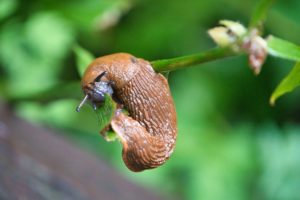
Slugs and snails can become a real problem in the garden. The question on every gardener’s mind: how do you get rid of them? How can we keep these gastropods out of our vegetable garden for good? That’s what we’re going to find out in this article.
If you've discovered my blog, you're probably bothered by slugs and snails.
You'd probably be very interested in the 7 Steps to get rid of slug by attracting the Alpha predator I have designed with the help of Science, and The slug-proof garden Design I have made (with the help of dozens of scientific studies too).
It changed everything for me. I can finally grow lettuces, cabbages, strawberries and cucurbits without pulling the hair out of my head.
Don't hesitate, you'll probably save a lot of time!
6 ways to get rid of gastropods in the garden
Here are 6 ways to get rid of garden slugs and snails (with fast, visible results):
Hand picking slugs:
By dint of your courage, at night, with a headlamp screwed on your head, you take advantage of the night’s dampness to collect the slime.
It’s a bit like mushrooms, with a little less enthusiasm in the hearts.
Once you’ve collected them in your big bucket, if you’re the forgiving type, you’ll release them far from home (more than 300 meters away, so they don’t risk coming back).
It’s a very effective way of getting rid of gastropods in the short term, as long as your motivation allows.
Slug pellets:
You can use iron phosphate granules if you want to decimate the slug population in your garden.
Slugs that ingest them will die.
The short-term effect is often quite clear.
Even if the long-term effects of using iron phosphate granules in the garden are still unclear to me (particularly as regards their potential impact on earthworms), it’s a solution that some traditional gardeners choose.
Anti-slug nematodes:
These are microscopic worms, which you can buy on specialized websites.
These nematodes are predators of slugs and snails, and will quickly eliminate their population.
Here too, short-term results are clearly visible. But nematodes are still quite expensive, and need to be applied frequently.
Indian racing ducks
These ducks, called “runners” because of their “raised” position (which gives us the impression that they are running), are fond of gastropods.
Adopt a pair of Indian runner ducks (note: you’ll need to build them a pond), and you can be sure they’ll get rid of all the slugs and snails in your garden.
But be careful, because adopting Indian racing ducks isn’t always a good idea when it comes to managing slugs in the garden.
Not least because they also crunch your salads, and for other reasons we’ll talk about below, in this article.
The chickens
After the ducks, the chickens!
While Indian racing ducks can rid your garden of large slugs, chickens can only tackle smaller slugs and eggs.
Chickens also have an annoying tendency to scratch the ground with their feet (quickly creating compacted, grass-free soil), and to chew up your plants.
The “chickens” option is therefore usually only conceivable with the use of screened tunnels or other temporary movable enclosures, enabling them to hunt slugs without damaging your vegetable garden too much.
Beer traps
Beer traps are a common solution for controlling slugs in the garden.
It’s true, slugs are very attracted to beer, and many of them end up drowned in the trap.
BUT – and this is why I put this “solution” last on this list – beer traps don’t actually get rid of slugs and snails, even in the short term.
It’s a little-known fact that the smell of beer attracts slugs so much that they come from far and wide in the direction of the beer traps.
From a distance, i.e. over 100 metres! So they come from your neighbors to you.
“But don’t worry, they’ll die in the beer” – I’m usually told.
That’s problem number 2: it turns out that no more than a third of the slugs attracted to beer traps end up drowning in them.
Is it a good idea to attract slugs to your garden from a radius of over 200 meters, and only eliminate a third of them? … Hmmm Kévin, I’m not sure the calculations are right.
In a nutshell,
beer traps are a bad idea for getting rid of slugs
… And you can study the subject in more detail in my dedicated article.
Are killing or moving slugs and snails really sustainable solutions?
As we said, there are several effective solutions to eliminate slugs from your garden.
At least in the short term.
And what does this mean in the long term?
What you need to know is that killing – or even moving – slugs creates what’s known as a yo-yo effect the problem disappears momentarily, then comes back… Sometimes even more so…
This is because an overpopulation of slugs in a garden, as Hervé Coves puts it so wellis a symptom of an imbalance in the garden..
Imbalance due to presence of natural predators of gastropods, which regulate – that regulate slugs over the long term.
But it is also often due to too little plant biodiversityThis is necessary to provide alternative “prey” for slugs, other than your rows of lettuces, when spring arrives.
And, if we eradicate slugs from the garden, their natural predators will never settle in..
The following season, the imbalance will be even greater. Slugs are then likely to return in even greater numbers.
That’s the yo-yo effect.
So, very often, what is recommended is don’t kill or move slugs from your gardeneven if that’s all you want. Just long enough for the rebalancing to take place.
But you’re right.
This wise patience is a little utopian, and few people can accept seeing their salads decimated overnight…
What about slug fences?
And yes? Slug fences!?
Eggshells, ashes, coffee grounds, fine sand, brambles, …
They protect your plants without killing the slugs.
You can therefore wait reasonably long enough to rebalance your garden.
But, as you sadly know, if you too have ever tried it : it doesn’t work. Or at least not sufficiently, not sustainably.
For example:
- Eggshells don’t work at all
- Ash, fine sand and sawdust are barriers that only work when they’re perfectly dry.
Etc…
You can view an analysis of each of these slug barriers in this article on
of several of these natural “anti-slug” products.
.
Even better! Follow scrupulously these 7 steps 👇
This is the action plan I devised following the findings of dozens of scientific studies on the subject.
I owe the success of my cabbages, salads, strawberries and cucurbits to it.
Click here to find out more:

Bibliography :
The study examines several different substances for their ability to repel slugs and snails. In particular, the results showed that copper had a repellent effect.

Robin
A passionate experimental vegetable grower, I had huge slug problems during my first 2 years of vegetable gardening.
Nothing (eggshells, ashes, etc.) seemed to work…
And yet, if the Internet was to be believed, everything was supposed to work…
In short, faced with an obvious problem of misinformation, I decided to take action: I tested all the famous “slug barriers”, so as to have a clear mind, and know what to do.
I filmed my (13) tests(here, in French)
The results were crystal clear: nothing was able to effectively block the path of slugs and snails, except Water, usable with trenches at least 5 cm deep and 10 cm wide, or Copper, if used vertically, if its height is at least 7 cm
But a water-based barrier is difficult to implement, and copper is expensive…
It was by turning to scientific studies that I found the solution: adopting a slug predator in the garden, present everywhere in the world, which has a huge regulatory effect on them.
The studies show it. And I called this predator the Alpha predator of slugs.
Using dozens of scientific studies again, I constructed an action plan of the most effective arrangements to attract this Alpha predator to the garden sustainably, and to see it multiply by itself, year after year, season after season.
And to get rid, definitively (and intelligently), of slugs.
I have gathered these 7 steps in a digital book that I propose on this site, and at the end of the book, there is also a video training module on designing a slug-proof garden.
You can find this digital book (which contains all of this) by clicking here.
And what if you don’t get rid of your slugs by following the advice in this book? It’s simple, I will refund you in full (but it will work, if you follow the instructions properly).
So, don’t hesitate to discover the simple 7 Steps that can change your springs.

0 Comments