
What’s the best natural anti-slug product?

If you've discovered my blog, you're probably bothered by slugs and snails.
You'd probably be very interested in the 7 Steps to get rid of slug by attracting the Alpha predator I have designed with the help of Science, and The slug-proof garden Design I have made (with the help of dozens of scientific studies too).
It changed everything for me. I can finally grow lettuces, cabbages, strawberries and cucurbits without pulling the hair out of my head.
Don't hesitate, you'll probably save a lot of time!
What products are available to effectively repel slugs?
That’s what we’re going to talk about here, according to this plan:
- First of all, let’s list the different natural products available to repel slugs
- Let’s take a look at some of these products to see if they can be used to repel slugs in the home.
- Then, we’ll do the same for the protection of plants in the vegetable garden.
- And finally, we’ll see ifthere are more interesting alternatives to these slug control products.
Slug control products
Here is a list of the various slug control products that exist and that can be considered natural:
Iron phosphate slug pellets: an artificial product with a natural active ingredient

These slug pellets kill the gastropods that eat them.
Some consider them natural, since iron phosphate, their active ingredient, is a natural mineral.
Despite this, the production process for these granules can involve processing and treatment steps, which can make them less natural than some other products.
Personally, I find it hard to see them as natural. Knowing, above all, thatthey could have a harmful impact on earthworms.
Lava stone barriers (pozzolana)

Here’s another potential purchase you might come across, on your way to a garden center.
In its box, it can easily be mistaken for slug pellets.
However, what we’re talking about here is a natural material to be spread on the ground (lava stone), to form a so-called anti-slug barrier.
Why so-called? Because I’m familiar with this type of material: it sometimes works when it’s completely dry (as is the case with ash, or fine sand), but becomes perfectly ineffective after rain, or in damp weather.
And when you read the customer reviews, you realize that one box will barely protect a 2 x 2-meter vegetable patch… which is quite expensive for a product of mixed effectiveness.
Diatomaceous earth
Diatomaceous earth is indeed a natural product, as it is made from the fossilized skeletons of diatoms, which are single-celled algae.
It is also an effective barrier to slugs: it even kills, on contact, any gastropods that try to cross it.
It’s an effective natural product for keeping slugs and snails at bay!
The only worry is that, in the garden, diatomaceous earth also kills, on contact, any insects that try to cross it, including beneficial insects such as ladybugs and carabid beetles (slug predators).
And it’s not yet clear what impact diatomaceous earth can have on the soil of a vegetable garden, whose role is to nourish the plants we’re going to eat, through the intermediary of essential soil life.
A spray of anti-slug product

It’s a
a spray
that I discovered, by chance, from RepellShiel.
This spray seems to have a fairly natural composition, based on caffeine, geraniol and cherrywood essential oil.
From customer reviews, it seems to work well for killing slugs by contact (by spraying them directly via this spray, if that’s your wish), and quite well for repelling slugs within homes.
On the other hand, its results seem very mediocre for plant and vegetable protection: this is a problem often encountered with repellents in liquid form: they dry out and/or evaporate quickly, and their effect disappears. Also, the slightest rainfall washes the product off the sprayed plants, returning it to the soil.
It is therefore a product to be used mainly in the home, as its effectiveness in the vegetable garden will be very mediocre.
Baking soda
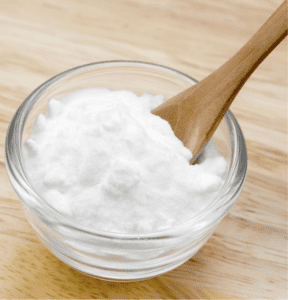
Baking soda can be considered a natural product, as it is produced from sodium carbonate and potassium carbonate, which are natural elements.
Baking soda placed on the soil will create an effective barrier against slugs, as its mode of action is similar to that of salt.
However, while using bicarbonate in the home can of course be beneficial, it’s questionable whether it’s appropriate for use in a vegetable garden, where rain will wash the bicarbonate into the soil, where its effects are unlikely to be positive.
Spirit vinegar

Spirit vinegar, or white vinegar, owes its effectiveness on slugs to its high acidity. Acidity that disrupts the membrane of the body’s cells, and can cause irreparable damage.
So, as with baking soda and spray, spirit vinegar can also be used in the home.
But less so in the vegetable garden, where vinegar’s very high acidity can similarly damage plants by disrupting their cell membranes.
What effective alternatives are there to these products to protect the vegetable garden?
In terms of slug barriers, the most effective, according to my tests, are :
- Moats” of water more than 5 cm deep and 10 cm wide. To create them, you can use semi-buried gutters, capped at the ends, which will fill up with water every time it rains. Slugs cannot penetrate water, and this system can protect entire planting beds.
- A vertical copper barrier more than 5 to 7 cm high. In fact, copper discharges a slight electric current (on contact with their mucus) which is very unpleasant for slugs, causing them to turn back quickly.
As proof of the effectiveness of copper, I suggest you watch this video:
The latest device tested is the pure copper barrier, which I designed and put on the market.
However, it’s important to remember that you shouldn’t be satisfied with simply installing a slug-proof barrier, and that you need to put in place a genuine long-term strategy to regulate the problem, including the sustainable installation of natural slug predators and the development of plant biodiversity.
Even better! Follow scrupulously these 7 steps 👇
This is the action plan I devised following the findings of dozens of scientific studies on the subject.
I owe the success of my cabbages, salads, strawberries and cucurbits to it.
Click here to find out more:

Scientific bibliography
-
The study examines several different substances for their ability to repel slugs and snails. In particular, the results showed that copper had a repellent effect.

Robin
A passionate experimental vegetable grower, I had huge slug problems during my first 2 years of vegetable gardening.
Nothing (eggshells, ashes, etc.) seemed to work…
And yet, if the Internet was to be believed, everything was supposed to work…
In short, faced with an obvious problem of misinformation, I decided to take action: I tested all the famous “slug barriers”, so as to have a clear mind, and know what to do.
I filmed my (13) tests(here, in French)
The results were crystal clear: nothing was able to effectively block the path of slugs and snails, except Water, usable with trenches at least 5 cm deep and 10 cm wide, or Copper, if used vertically, if its height is at least 7 cm
But a water-based barrier is difficult to implement, and copper is expensive…
It was by turning to scientific studies that I found the solution: adopting a slug predator in the garden, present everywhere in the world, which has a huge regulatory effect on them.
The studies show it. And I called this predator the Alpha predator of slugs.
Using dozens of scientific studies again, I constructed an action plan of the most effective arrangements to attract this Alpha predator to the garden sustainably, and to see it multiply by itself, year after year, season after season.
And to get rid, definitively (and intelligently), of slugs.
I have gathered these 7 steps in a digital book that I propose on this site, and at the end of the book, there is also a video training module on designing a slug-proof garden.
You can find this digital book (which contains all of this) by clicking here.
And what if you don’t get rid of your slugs by following the advice in this book? It’s simple, I will refund you in full (but it will work, if you follow the instructions properly).
So, don’t hesitate to discover the simple 7 Steps that can change your springs.

0 Comments