
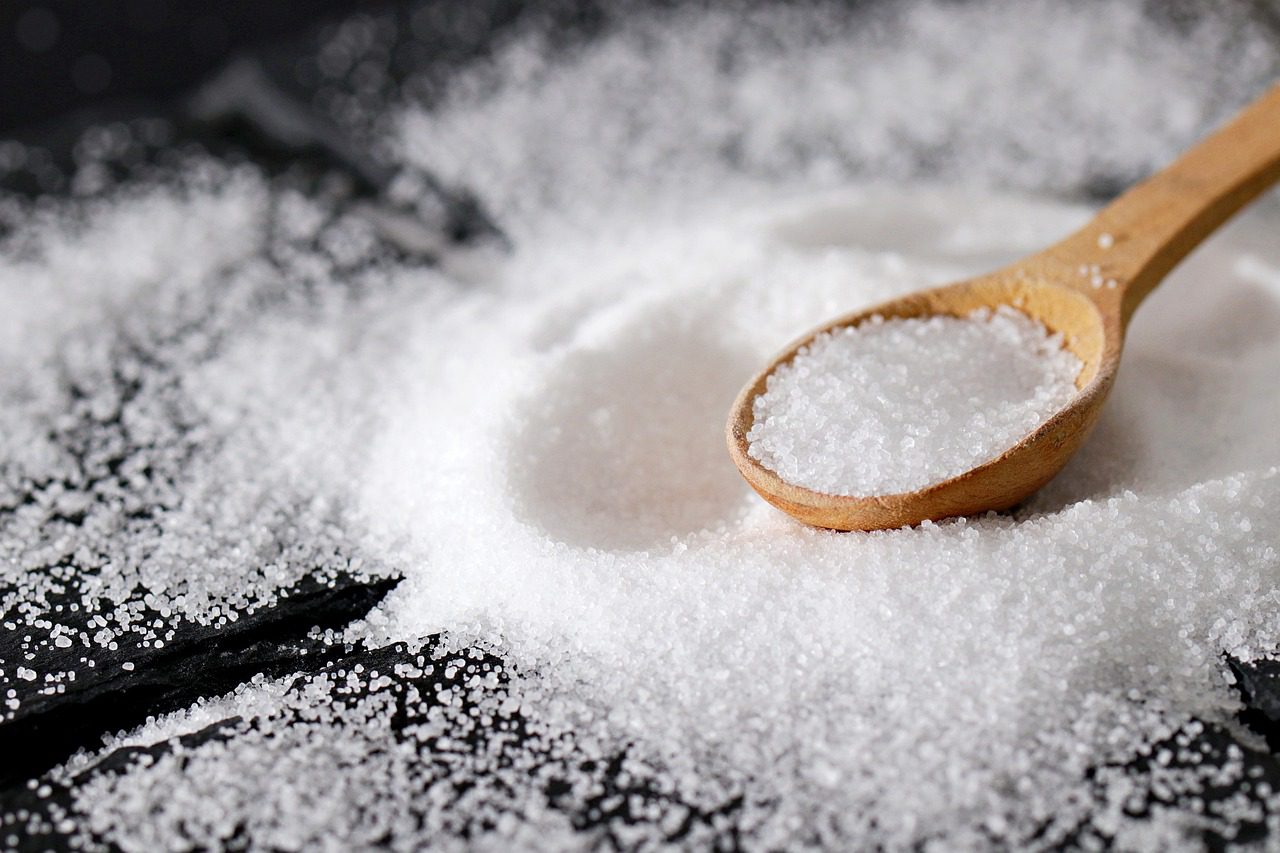
Don’t use salt to kill slugs in your garden!
In this article, I’ll try to answer several questions:
Why and how is salt used against slugs in the garden?
Why and how does it kill these poor gastropods?
Are they suffering? Mini-confrontation between Descartes and Ned Block
Using salt against slugs: what are the side effects for your garden?
Why does salt kill your plants and impoverish your soil?
What are the effective alternatives to using coarse salt against slugs in the vegetable garden?
Slugs are a thorny issue. And yes, because everyone has something to say about slug control in the garden. In fact, you’ve probably already heard someone tell you that salt is the best method anyway: “Brush them with coarse salt like a good prime rib, it works like a charm! “You have to make them die anyway.
But then, when these words reach your ears, no matter how ardently you feel that “no, that’s not the right thing to do”, you stammer, lose your arguments, no longer know, in front of the incisive eye of this sanguine energetic man, so sure of his words.
Here are a few arguments on the subject, which you can draw on, before loudly voicing your disagreement, accompanied or not by a symphony of violins (for emotion)! 😀
First, we’ll see why salt is used against slugs, and why and how it kills them (does it “melt” slugs?)…
Then we’ll look at why it’s a very bad idea to use salt against them, with 4 arguments, followed by the effective alternatives that exist to this method.
We’ll also look at the chemical process that makes salt sometimes used as a weedkiller, and whether it’s advisable to use it as such.
Here we go!
If you've discovered my blog, you're probably bothered by slugs and snails.
You'd probably be very interested in the 7 Steps to get rid of slug by attracting the Alpha predator I have designed with the help of Science, and The slug-proof garden Design I have made (with the help of dozens of scientific studies too).
It changed everything for me. I can finally grow lettuces, cabbages, strawberries and cucurbits without pulling the hair out of my head.
Don't hesitate, you'll probably save a lot of time!
But beforegoing any furtherI suggest you read the thumbnail article below, because it gives a global understanding of the problem common to all these “bad” solutions. Then return to this one.
Slug management: methods to avoid
I. Why and how is coarse salt used against slugs in the vegetable garden?
Last time, I was looking for a little inspiration for an article on one of the urban (or rural, as it were) legends of homemade, “natural” slug control in the vegetable garden. Then I came across numerous articles advocating the use of salt.
This weapon of mass destruction of gastropods is used in two forms:
– Ground defense: wall of coarse salt around plants

– Air offensive: coarse salt bombardment directly on gastropod landings (civilian and military, without differentiation).

The purpose of the wall is to kill (by contact) any slugs that want to get through it, with the aim of nibbling your lettuces.
The aim of aerial bombardment is to eliminate the “ enemy “ directly, on the battlefield, by contact here too.
But how is it that simple contact with salt can kill slugs?
II. Why does salt kill slugs?

To answer this question, you have to remember high school chemistry classes: aie, ça remonter?
Don’t worry, it’s actuallyquite simple.
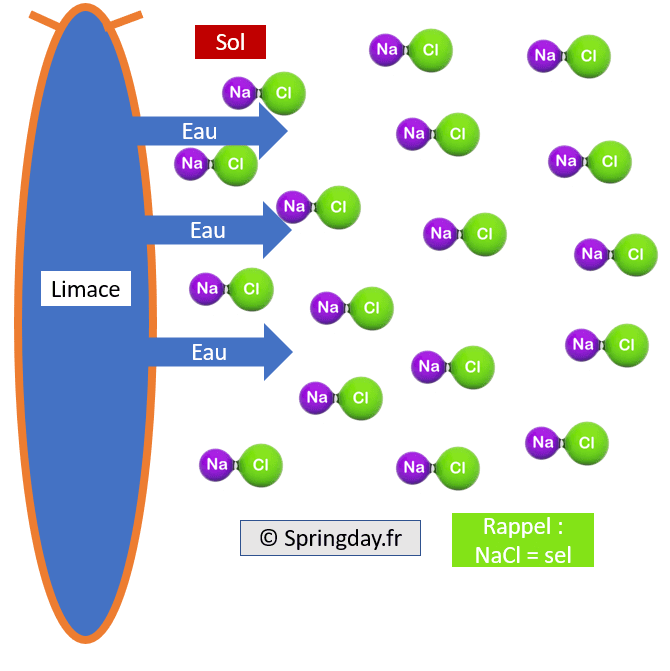
In fact, in both water (H2O ) and salt (NaCl), each molecule is charged (with charges called partial charges). Without going into too much detail, it turns out that NaCl molecules (i.e. salt) are attracted to water molecules (H2O): that’s why salt dissolves in water, because H2O and NaCl molecules attract each other and “fuse”.
But if you put salt on a membrane over the water (the membrane separates the water from the salt), the water will be so attracted to the salt that it will pass through the membrane and merge with it : this is called “ osmosis”.
This is what happens when salt is added to water-logged foods such as tomatoes: the water “comes out” of the tomato to impregnate the salt, within which it is then trapped. The tomato then dries out, losing its water.
Well, slugs are no different. It’s a membrane (its skin, which is also porous) filled with water. So, salt on a slug will absorb all its moisture (its water), and it will dry out and die. :'(
So the slug doesn’t melt under the effect of salt, it dries out…

Robin
A passionate experimental vegetable grower, I had huge slug problems during my first 2 years of vegetable gardening.
Nothing (eggshells, ashes, etc.) seemed to work…
And yet, if the Internet was to be believed, everything was supposed to work…
In short, faced with an obvious problem of misinformation, I decided to take action: I tested all the famous “slug barriers”, so as to have a clear mind, and know what to do.
I filmed my (13) tests(here, in French)
The results were crystal clear: nothing was able to effectively block the path of slugs and snails, except Water, usable with trenches at least 5 cm deep and 10 cm wide, or Copper, if used vertically, if its height is at least 7 cm
But a water-based barrier is difficult to implement, and copper is expensive…
It was by turning to scientific studies that I found the solution: adopting a slug predator in the garden, present everywhere in the world, which has a huge regulatory effect on them.
The studies show it. And I called this predator the Alpha predator of slugs.
Using dozens of scientific studies again, I constructed an action plan of the most effective arrangements to attract this Alpha predator to the garden sustainably, and to see it multiply by itself, year after year, season after season.
And to get rid, definitively (and intelligently), of slugs.
I have gathered these 7 steps in a digital book that I propose on this site, and at the end of the book, there is also a video training module on designing a slug-proof garden.
You can find this digital book (which contains all of this) by clicking here.
And what if you don’t get rid of your slugs by following the advice in this book? It’s simple, I will refund you in full (but it will work, if you follow the instructions properly).
So, don’t hesitate to discover the simple 7 Steps that can change your springs.
III. Why using coarse salt against slugs in the vegetable garden is such a bad idea?
a. Ineffective salt after rain

In the case of a coarse salt barrier, the first thing to say is thatafter the first rainfall, the salt will dissolve and seep into the ground: no more barrier. And the hordes of gastropods will be happy to take revenge on your cabbages for your bad intentions 😉
b. Why and how does salt kill plants, soil and living creatures?
Whether salt is thrown at slugs and snails, or used as a barrier to protect your plants, in both cases it takes place in – or near – your vegetable garden.
But did you know that the salt absorbed by the earth is very harmful to its health, as well as to that of the organisms it inhabits, and also harmful to the health of your plants?
The impact on plants comes from the osmosis phenomenon we’ve already seen. The much higher salt concentration on the outside of plant roots will attract the water contained in these roots (more precisely, the water contained in the root cells). Root water will therefore be drawn away from the roots and “trapped” by the salt. The roots will dry outand the plants will die. This is called plasmolysis.
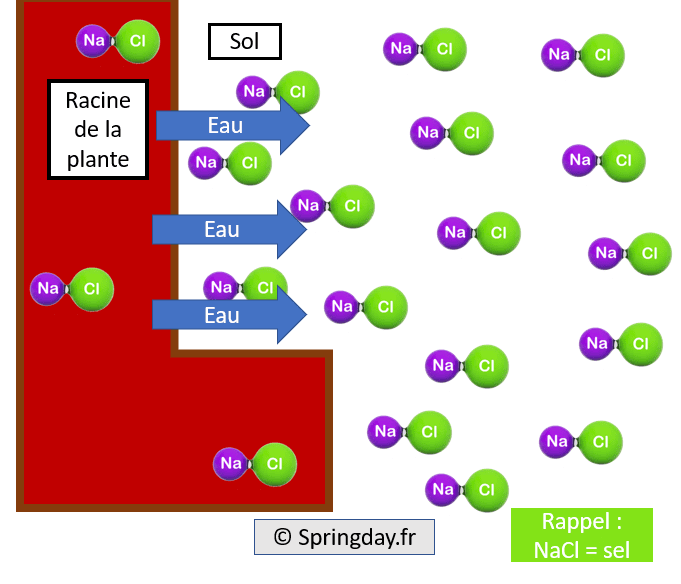
By the same token, salt kills the vast majority of soil bacteria and fungi (which make for rich soil), as well as earthworms and many insects.
The use of salt in the garden is therefore a disaster for the soil and the whole system, which is seriously disrupted.
c. Salt on slugs: a great suffering? Descartes and Ned Block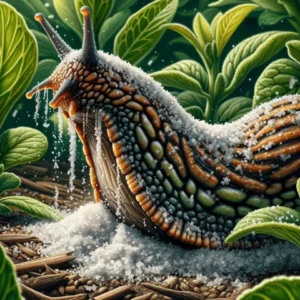
Dédé, the red-hot energy man from earlier, is convinced: “These animals don’t suffer, you see… What’s the point in tying knots in their heads? We’d know if slugs could suffer…”
What Dédé says may seem a little silly at first sight… But a little digging reveals that the answer isn’t as simple as it seems.
Do slugs, like other molluscs, have the physiological and cognitive capacity to suffer in the sense we understand?
First of all, what does it mean to suffer?
Almost all living beings have what we might call (for simplicity’s sake) a receptor system, designed to help them naturally avoid sources of danger in the environment that could compromise their survival.
It’s a mechanism that favors the survival of the species in question, and is maintained over generations by natural selection.
Basically, if an insect approaches a campfire, for example, it will, at some point, turn back (its body sensing the high heat), rather than make its way into the flames, and die burnt. Its heat “receptor system” enabled it to avoid danger from the environment, and thus to survive.
The same applies to a slug that encounters a barrier of coarse salt: touching the material, it will suddenly retract, then turn back.
This type of behavior, so similar to our own – when we clumsily place our hand on a hot plate, for example – immediately makes us think of the pain we feel in this type of situation.
Does this necessarily imply real pain for slugs, when coarse salt is thrown on them, for example?
Descartes saw animals as highly sophisticated machines: it is possible to equip a robot with a set of sensors to detect environmental threats. It is also possible to program defense or escape mechanisms against these potential dangers. A robot equipped in this way, now or when technology permits, will give us the impression, under certain conditions, that it feels a certain type of pain.

And yet, although his “body” will react as such, he will neverfeel pain.
In fact, the ability to feel pain as we understand it, requires some form of awareness. This is phenomenal consciousness, as defined by philosopher Ned Block.
Phenomenal consciousness, as he puts it, is “what it feels like”, the subjective experience, the qualitative, what we can’t really understand without experiencing it.
This phenomenal consciousness may, according to some scientists, only exist in living beings with a well-developed and complex brain and nervous system. It is accepted, for example, that all mammals have a phenomenal consciousness (that they subjectively feel pain, therefore; but also that they subjectively perceive their environment, etc.).
However, this conclusion is based on an extrapolation from our own human bodies: mammals have similar anatomical and cognitive characteristics, and are therefore considered to be subjectively conscious, just as we are.
This leads some scientists to believe that molluscs lack subjective sensations, their composition being too far removed from our own.
Other scientists dispute this point of view, arguing, by definition, that we cannot understand what another living being subjectively experiences, and that faint anatomical or cognitive similarities prove nothing.
We already can’t really understand how another human feels when they bite into chocolate, or fall in love.
Let alone understand what it’s like to be a slug. As the animal kingdom has diverged significantly over the course of evolution, the gates to sensoriality (the anatomical and cognitive features responsible for subjective sensory experience) cannot be reduced to the nervous and cerebral system as found in us humans.
Yuval Noah Harari already shares the idea that other living beings may well have far richer subjective sensory experiences than we do. These experiences could be very different in origin and appearance from our own, which is why it will probably never be possible for us to know, for example, what it’s like to be a slug.
But when in doubt about the presence or absence of phenomenal consciousness in slugs, and according to the precautionary principle (which I think we should apply much more to certain other spheres of our world!!)But it’s better not to subject these precious garden helpers to a potentially agonizing and slow death (yes, the osmosis drying process on a living being is potentially agonizing). Well, that’s just my opinion 😉
d. Why killing slugs is not good for your garden?
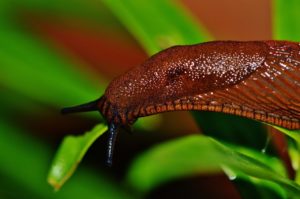
And yes, slugs really do play an essential role in the garden! For example, they prevent the spread of pathogenic fungi, and encourage the development of mycorrhizal soil fungi! Among other things, because the benefits are many…
“Okay, they’re very nice to encourage mycorrhizae, the ladies, but my cabbages are all you want, but they ‘re not favored.”
Yes, it’s true that major damage to our plants can be hard to take, but that’s why we’ve come up with some effective alternatives to the use of salt!
IV. What are the effective alternatives to using coarse salt against slugs in the vegetable garden?

In fact, there are many alternatives to salt for managing slugs in the garden.
But what they all have in common is that they don’t involve the mass eradication of a slug population.
Because, what I could also have explained in the paragraph above, and have already shared in several articles, is that slugs are only a symptom of an imbalance in our garden. A young garden (which is a modification of an original ecosystem), for example, will probably be inundated with slugs for several years, before a natural rebalancing takes place (reflected by a low stabilization of the slug population).
This rebalancing goes through many stages, one of which, for example, is the sustainable installation of slug predators. Get rid of the slugs, and the predators of gastropods won’t settle near you, unable to find their prey.

The method I promote on this site, and for the management of most small garden “pests”, is based on this long-term regulation.
So, even methods whose primary aim is to reduce the damage caused in the vegetable garden, need toembrace this long-term regulation, rather than oppose it. All methods of mass slug eradication work against this long-term, sustainable regulation.
Conversely, targeted repulsion, distraction or barrier (plant protection) methods limit or even prevent damage, without compromising long-term natural regulation.
Conclusion:
Salt is one of the worst ideas for dealing with slugs in the garden.
In addition to being based on a method of action that I think can only be described as “barbaric” (but whose process you now understand!), it severely and sustainably impoverishes our soil and all its living beings.
Just because an element is natural doesn’t mean it’s necessarily beneficial or desirable in the garden. Salt is a good example, but there are many others.
Even better! Follow scrupulously these 7 steps 👇
This is the action plan I devised following the findings of dozens of scientific studies on the subject.
I owe the success of my cabbages, salads, strawberries and cucurbits to it.
Click here to find out more:

Bibliography :
- A. Ester, K. van Rozen, L.P.G. Molendijk,
Field experiments using the rhabditid nematode Phasmarhabditis hermaphrodita or salt as control measures against slugs in green asparagus, Crop Protection, Volume 22, Issue 5, 2003 - Nagel, T. (1974). What is it like to be a bat? Philosophical Review, 83(4), 435-450.

0 Comments