
Surface composting, protect your vegetable garden from slugs, with love
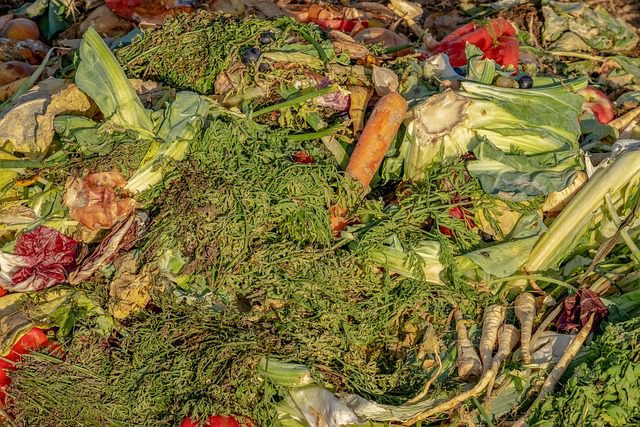
In this article, I’ll give you a brief overview of the advantages and disadvantages of surface composting for general use in permaculture. The green section is a little more technical.
Then, I’ll share with you why and how to avoid the “slug war”, how surface composting is a “magic” way to finally garden with them, and give you some practical tips for setting up this composting.

Before going any furtherif you’re worried about slugs in your garden, there’s an article you really need to read. absolutely that you’re reading, because it brings together all the solutions presented on my website. It’s the “slug control in the garden” article, linked just below. I suggest you read it, and then come back.
Slug control: summary and video tests
I. Why surface composting?
You’ve often heard of surface composting, but for you nothing beats a good compost in a corner of the garden?
So why are so many people using this permaculture composting technique?
I’ll try to keep it short and to the point, by explaining the pros and cons of what I’ve learned on the subject.
1. But what is surface composting anyway?

Surface composting is basically composting that takes place directly on the soil of your vegetable garden! If I use this technique, in addition to (or instead of) my mulch, I’ll add all my organic waste traditionally destined for the composter, between my rows of plants.
2. Advantages :

- Ideal for the lazy ( 😉 ) or the “autonomous vegetable garden” enthusiasts : you love to enjoy your vegetables without spending too much time having to manage everything? Are you a fan of the massive use of oyas rather than spending hours emptying your region’s water tables? Surface composting saves you the work of maintaining a “hot” compost heap, and means you don’t have to go back and forth to it (or even a cold composter) to feed your soil with good, fresh compost. Also, green waste is excellent for helping to maintain a super-humidity level in your soil, so you can water much less (if at all!). It’s a great thing to combine with oyas, for those who don’t want to water anymore, even in very dry regions.
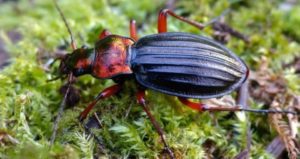
- You’re clearly boosting the life of your soil! Ketoons, springtails, sowbugs, blaniules … and other small and micro-organisms will digest this organic matter on the spot. This will also attract their predators, promoting biodiversity right on the spot, not just in the remote corner of your vegetable garden. And richer biodiversity means a more stable, resilient garden!
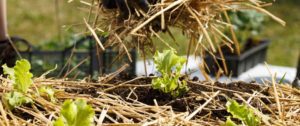
- Are you afraid of being hit by the dreaded nitrogen hunger that makes you and your family tremble and turn your nights white?
Surface composting has the answer to everything!
I’m exaggerating a little, but if you’re in the habit of mulching your garden to preserve soil life, a regular supply of nitrogen-rich organic matter (your peelings and other green waste) will balance your carbon/nitrogen ratio, greatly reducing the risk of nitrogen starvation.
It’s also a way of getting as close as possible to a natural biotope, because in the forest, for example, plant waste, fruit or fruit remains, are found at ground level, in a homogeneous distribution.
3. Disadvantage :

- It’s not very aesthetic: “Well, I don’t really want my garden to look like a rubbish dump”. Yes, it’s true that if all your organic waste is in plain sight when you’re relaxing in your garden, it’s not the most pleasant thing, visually speaking. But mixed with mulch, it’s highly likely that they’ll be almost invisible. But it’s true that it’s perhaps more aesthetically pleasing to limit this type of composting to your ornamental plants and flowers, often in close proximity to where you live.
- This plant waste can attract slugs in the direct vicinity of your vegetable garden. Yes, it’s true, but it’s also a way to distract them from your plants! (You’ll see all this in the next section).
Special section: Why does surface composting reduce the risk of “nitrogen starvation”?
When you mulch your vegetable garden with straw, the carbon/nitrogen ratio of this input is unbalanced: in fact, the C/N ratio of straw is 100. This means that straw is composed of 100 times more carbon than nitrogen.
However, decomposition of 100g of carbonaceous matter requires the mobilization (by the soil micro-organisms responsible for this decomposition) of 4g of nitrogen, on average.
For every 100 grams of straw to be decomposed by the micro-organisms, 4 grams of nitrogen need to be mobilized. But straw contains only one gram of nitrogen per 100 grams of material! 3 grams of nitrogen contained in the soil will then be mobilized by soil micro-organisms until the straw is completely digested. This nitrogen in the soil can no longer be taken up by your plants, leading to nitrogen starvation.
To limit this phenomenon, we need to rebalance the carbon/nitrogen ratio, in particular by adding nitrogenous matter to the soil (green waste, for example). So, if you add nitrogen to the soil micro-organisms, they will no longer need to mobilize the nitrogen already present in the soil, which can then be taken up by your plants.
Here is a list of different nitrogen-rich materials with their C/N ratio, which, in addition to surface composting, can help you end nitrogen hunger (source: permaculture in the garden by Damien Dekarz):
- Urine: 0.70
- Meat: 1
- Animal manure: between 5 and 10
- Fresh grass: between 10 and 15
- Green leaves: between 10 and 20
- Kitchen waste (peelings, etc.): 20

Robin
A passionate experimental vegetable grower, I had huge slug problems during my first 2 years of vegetable gardening.
Nothing (eggshells, ashes, etc.) seemed to work…
And yet, if the Internet was to be believed, everything was supposed to work…
In short, faced with an obvious problem of misinformation, I decided to take action: I tested all the famous “slug barriers”, so as to have a clear mind, and know what to do.
I filmed my (13) tests(here, in French)
The results were crystal clear: nothing was able to effectively block the path of slugs and snails, except Water, usable with trenches at least 5 cm deep and 10 cm wide, or Copper, if used vertically, if its height is at least 7 cm
But a water-based barrier is difficult to implement, and copper is expensive…
It was by turning to scientific studies that I found the solution: adopting a slug predator in the garden, present everywhere in the world, which has a huge regulatory effect on them.
The studies show it. And I called this predator the Alpha predator of slugs.
Using dozens of scientific studies again, I constructed an action plan of the most effective arrangements to attract this Alpha predator to the garden sustainably, and to see it multiply by itself, year after year, season after season.
And to get rid, definitively (and intelligently), of slugs.
I have gathered these 7 steps in a digital book that I propose on this site, and at the end of the book, there is also a video training module on designing a slug-proof garden.
You can find this digital book (which contains all of this) by clicking here.
And what if you don’t get rid of your slugs by following the advice in this book? It’s simple, I will refund you in full (but it will work, if you follow the instructions properly).
So, don’t hesitate to discover the simple 7 Steps that can change your springs.
The 7 Steps Action Plan to definitively (and intelligently) get rid of slugs (and snails).

II. Surface composting, or how to garden with slugs without waging war on them.
1. The “slug war” and surface composting, and why it works

Slugs… quite a business…
Every year, with the first rains of spring, hundreds, even thousands of calls for help spring up in permaculture groups on Facebook.
Faced with population explosions of these gastropods, which reproduce and grow very quickly in spring, seedlings and young plants often don’t last long.
So we bring out the artillery:
- Counter-productivity tanks: slug pellets and beer traps
- Bunkers of ash and eggshells, of dubious effectiveness (video proof)
- Armed with earth: cavalry of Indian racing ducks, infiltrating nematodes
Even the protective walls plants, some of which are highly effective (you can click here to see all slug barriers or click here for a test and comparison of copper fences), are not always suitable for an entire garden, and recruiting native troops (hedgehogs, ground beetles, staphylins, etc.) can sometimes take a long time.
What if all it took was a change of mindset? What if we decided not to see slugs and snails as enemies, but as allies in vegetable fruiting?
What if they weren’t acting as the wrath of elusive higher holistic forces, but rather as a symptom, an indicator to help you discover the syndrome affecting your garden?
It appears that this is in fact often the case. The rebalancing process can take a long time, but it requires that gastropods are not killed or excluded from the vegetable garden system. Otherwise, for example, natural predators won’t settle in.
So how can you protect your plants from slugs without using methods that will harm them?
A superb solution to this problem is surface composting.
Slugs have a natural role to play in digestion (of organic matter in the initial stages of decomposition, in particular, which limits the spread of pathogenic fungi! If they have any available, they will prefer to use plant waste rather than your seedlings.
If they’re sometimes very voracious in spring, it’s precisely because they’re starving: in spring, all life starts up again, and the proportion of vegetation in the early stages of decomposition is much rarer than at other times of the year.
Feed them, and they should leave your plants alone. Banana peels, wilted salad leaves and potato peelings are their thank-you gifts for all their hard work. (Thanks to Eric from the ” permaculture: pests and rebalancing ” group for the inspiration).
Give love, avoid war!
2. Practical tips for surface composting for slugs

Okay, so you’re obviously keen to try out surface composting in the face of those incessant streams of slugs ravaging your vegetable garden.
Yes, but do I have to set up surface composting in a particular way?
In fact, not so much, but a little all the same, let me explain:
Your surface compost will need to be fairly evenly distributed to reap these benefits for your soil’s good health. But, in a primary use case for seasonal slug management, you can set up three things:
- Distribute surface compost so that its density is greater on the periphery of the garden than inside (to keep slugs as far away as possible from the most sensitive areas).
- Don’ t place too much compost (or any at all) in the direct vicinity of your plants: this could encourage the development of pathogens (downy mildew for tomato plants, for example).
- If you’re gardening in tubs, it may be a good idea to place some of the compost on the ground, sunken around the tubs: the slugs will stop there before climbing the tubs. Add a little compost to your planters to benefit from its benefits for soil life and your plants.
- You can also opt for surface composting in a remote corner of your garden, away from your vegetable garden: this will attract the majority of slugs, diverting them from your garden (a technique similar to that of a sacrificial bed).
- Finally, the amount of surface compost to be put in place needs to be regulated over time and in quantity (not too much at once): for an understanding of why this is so, here’s an article that explains it in detail (Slugs: role, indications, and regulation by restructuring the system).
3. What if the slugs devour your plants anyway?

If slugs still attack your most sensitive plants, I think the use of effective barriers around them can solve the problem in the short term. The combination of the two solutions is often very effective, and in no way excludes slugs from the garden!
For longer-term control of the problem, you can plant naturally repellent plants, attract slug predators or restructure your soil (to attract mycorrhizal fungi in particular).
Conclusion
Surface composting is a practice increasingly used in permaculture, and for good reason: it promotes soil life, requires less work in the garden, has a better C/N ratio… but it’s also an effective way of gardening with slugs, enjoying their undeniable benefits while limiting the damage to your plants!
Finally, avoiding war with slugs, offering them compost as a gift and protecting your plants are all compatible!
Even better! Follow scrupulously these 7 steps 👇
This is the action plan I devised following the findings of dozens of scientific studies on the subject.
I owe the success of my cabbages, salads, strawberries and cucurbits to it.
Click here to find out more:

0 Comments